Beyond the Bloom: The Many Lives of Asia’s Sacred Lotus
In our previous journeys through Asia’s indigenous wisdom, we looked at two of the region’s most versatile plants, the coconut and the banana. The traditional use of both the coconut and the banana in Asia, demonstrates an old and remarkably practical way of living with nature, of using what is available, of finding another purpose for what might otherwise be discarded and allowing very little to go to waste.
And the lotus offers another particularly beautiful example.
For centuries Nelumbo nucifera has occupied a special place in Asian culture. Its flower is associated with purity, renewal, and spiritual awakening, as the beautiful blooms rise from muddy water to flower above the surface of the water. Yet the lotus flower’s significance extends well beyond this symbolism.
Look more closely and almost the entire plant has a purpose.
The flower becomes an offering and, in the kitchen, an ingredient. The seeds become both a savoury food and delicate sweets. The broad leaves become natural food wrappers. The rhizome becomes a crisp and versatile vegetable. Young stems and shoots appear in Southeast Asian dishes. And in Myanmar, the fine fibres hidden within the stems are painstakingly transformed into one of the world’s rarest natural textiles.
The lotus is not simply admired. It is used, understood and respected in its entirety.
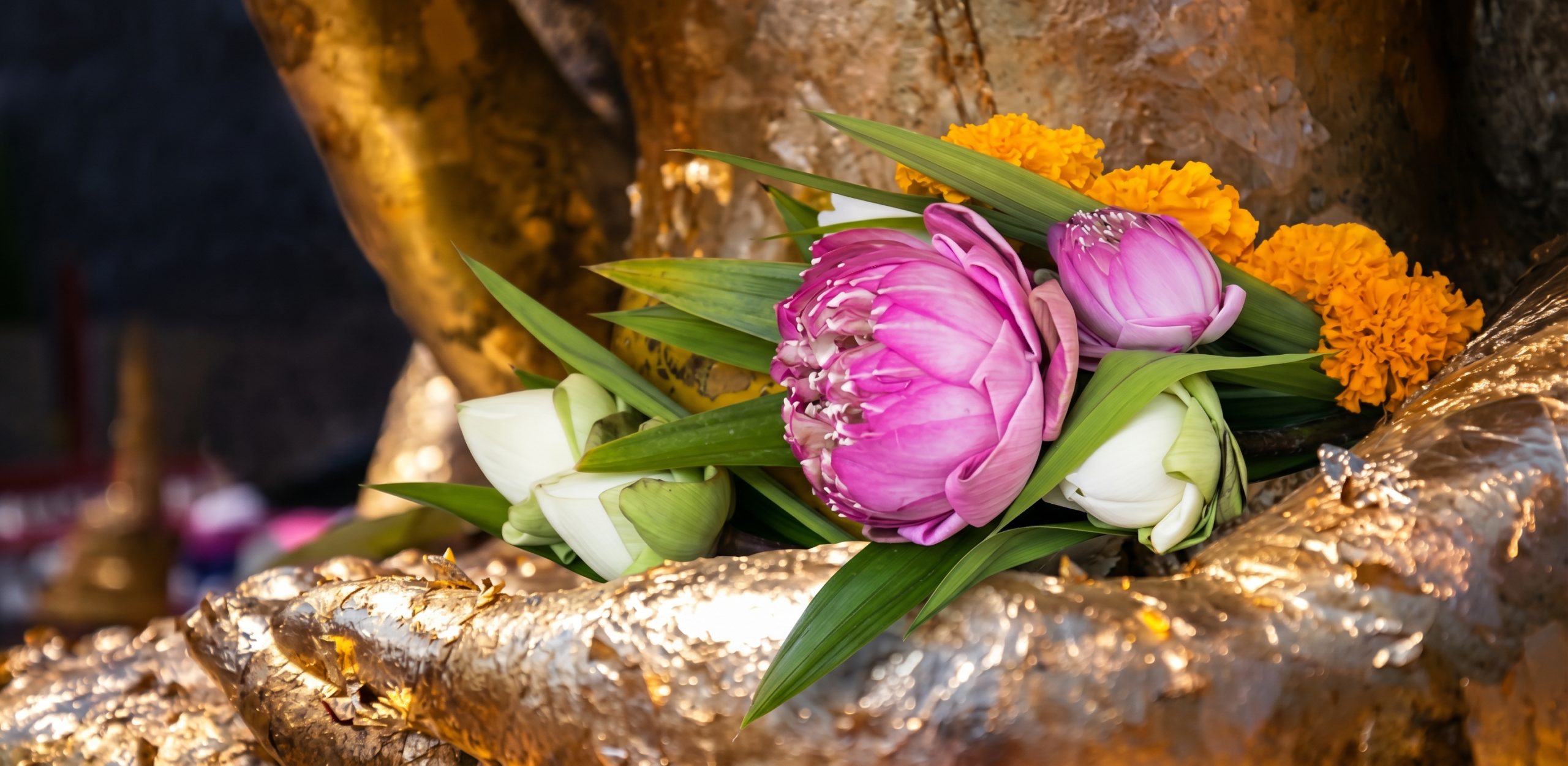
The Flower: An Offering of Purity and Devotion
Across much of Buddhist Asia, the lotus flower is among the most recognizable of all the offerings placed before Buddha images and at temples.
Its symbolism is deeply rooted in the way the flower grows with its roots deep in the mud of a lake or pond bottom, its stem rises through the water, and the flower opens cleanly above the surface. The journey from darkness to light has come to represent the possibility of spiritual awakening, of rising above attachment and suffering without being defined by what lies beneath, or what’s gone before.
Fresh lotus flowers may be offered at temples, placed on household altars, or carefully folded and arranged as offerings. In Thailand, Cambodia, Laos, Myanmar, and Sri Lanka, the flower is therefore not simply decorative. Offering a lotus can be an act of respect, devotion, and generosity.
There is something particularly fitting about a plant that is so deeply associated with giving. The same flower that is offered in a temple also provides food, fragrance, medicine, wrapping, and a fine thread to weave fabric with.
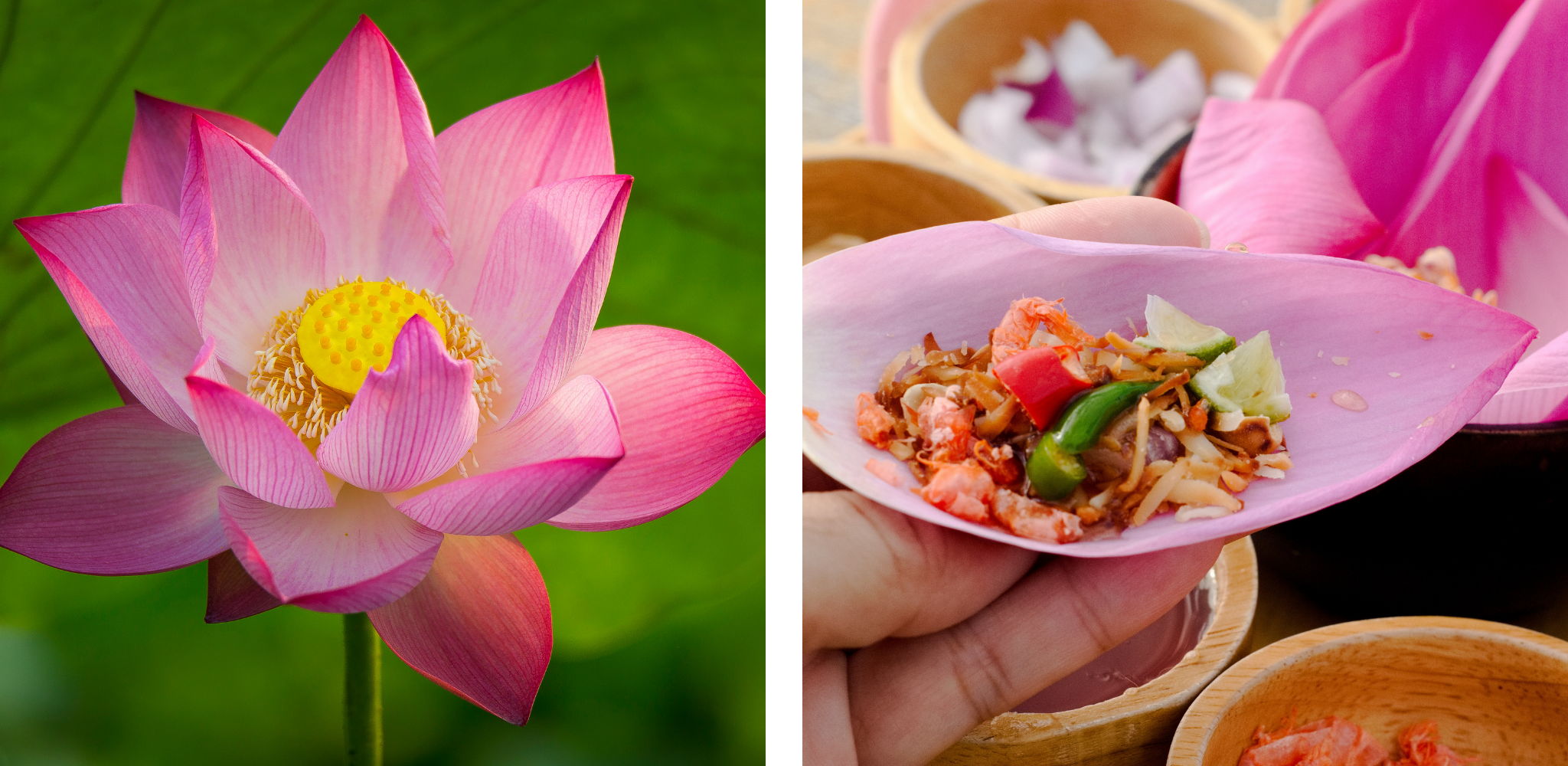
The Petals: From Temple Flower to Dining Table
The lotus does not have to remain on the altar.
In Thailand, tender lotus petals can become elegant, edible vessels in Miang Kham Gleeb Bua. Instead of the more familiar betel or leaf wrapping, individual petals cradle toasted coconut, shallot, chilli, lime and peanuts, creating a delicate contrast between the flower’s softness and the intensity of the ingredients.
The petals themselves are part of the experience, fragile, faintly floral, and almost too beautiful to eat.
Lotus flowers can also be used in fried preparations, where the petals are lightly coated and quickly cooked until crisp. Their natural shape remains visible, turning something traditionally associated with contemplation and ceremony into something unexpectedly playful, and delicious, at the table.
In China, lotus flowers have also found their way into culinary and tea traditions. Petals may be used in teas and other preparations, while the flower’s fragrance has long been appreciated alongside green tea.
And in Vietnam, the relationship between lotus and tea reaches another level of delicacy.
Around Huế, the lotus is closely associated with Vietnamese tea culture. Traditionally, green tea leaves are placed inside lotus flowers so that they can absorb the flower’s fragrance. The flowers are gathered and the scented tea carefully prepared, sometimes through repeated rounds of infusing fresh lotus blossoms with tea.
It is an unusually patient way of capturing fragrance, not through artificial flavouring, but by allowing tea and flower to meet naturally.
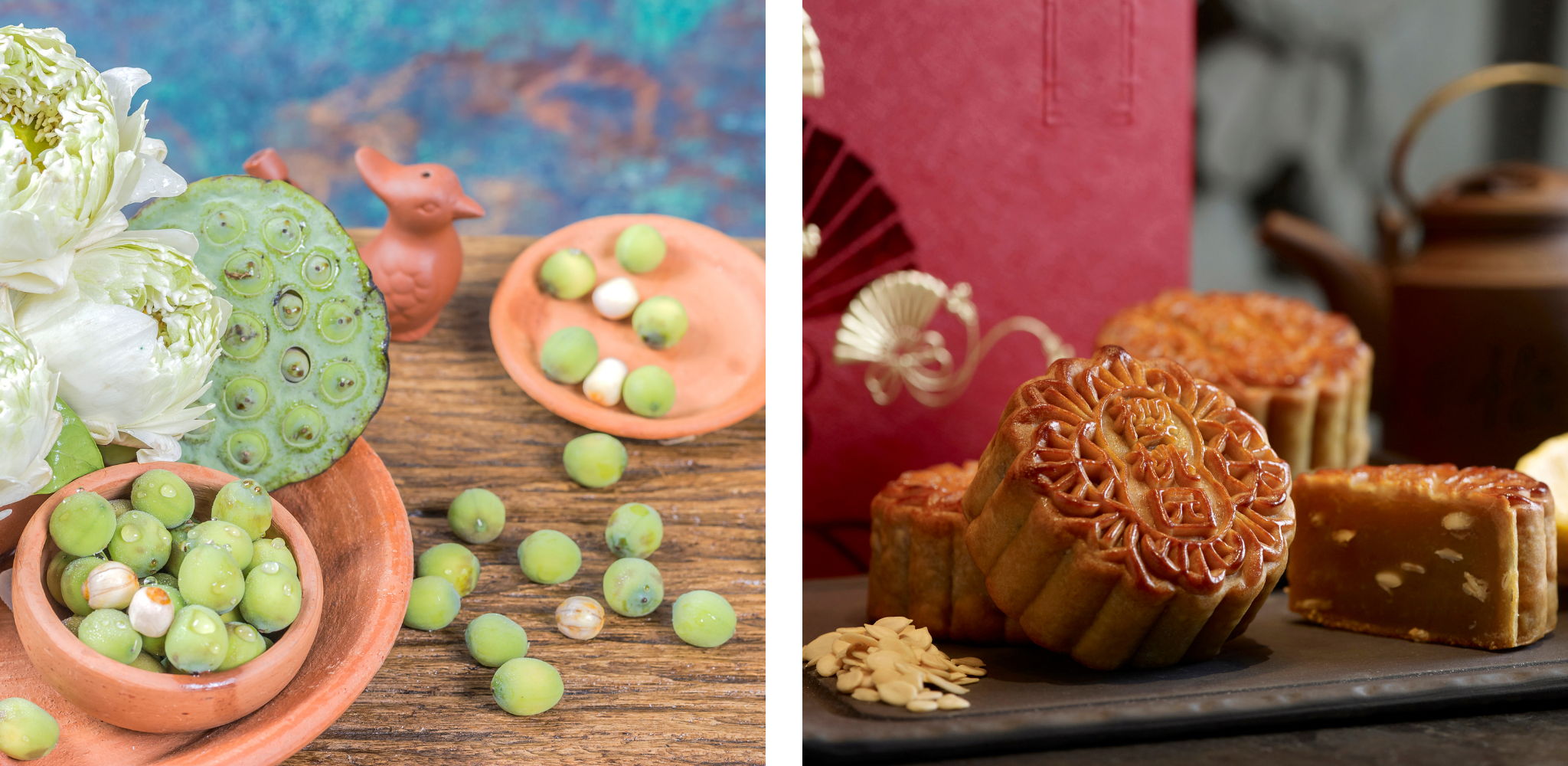
The Seeds: From Savoury Dishes to Mooncakes
In China, lotus seeds have long occupied both the everyday kitchen and the festive table.
Fresh seeds can be eaten young, while dried seeds are softened and used in soups, congee, and other savoury preparations. They are also transformed into liánróng, a smooth lotus-seed paste made by cooking, puréeing, and sweetening the seeds.
The result is one of the classic fillings of Chinese pastry, most famously the lotus-seed mooncake enjoyed during the Mid-Autumn Festival. Lotus seed paste is also used in steamed buns and other sweets.
Even the small green germ found inside the seed has its own traditional use. Known as lián zǐ xīn, it is used in Chinese herbal preparations and teas.
One seed, therefore, can move from soup to pastry to herbal infusion. Another small illustration of how thoroughly traditional food cultures have learned to use what a plant provides.
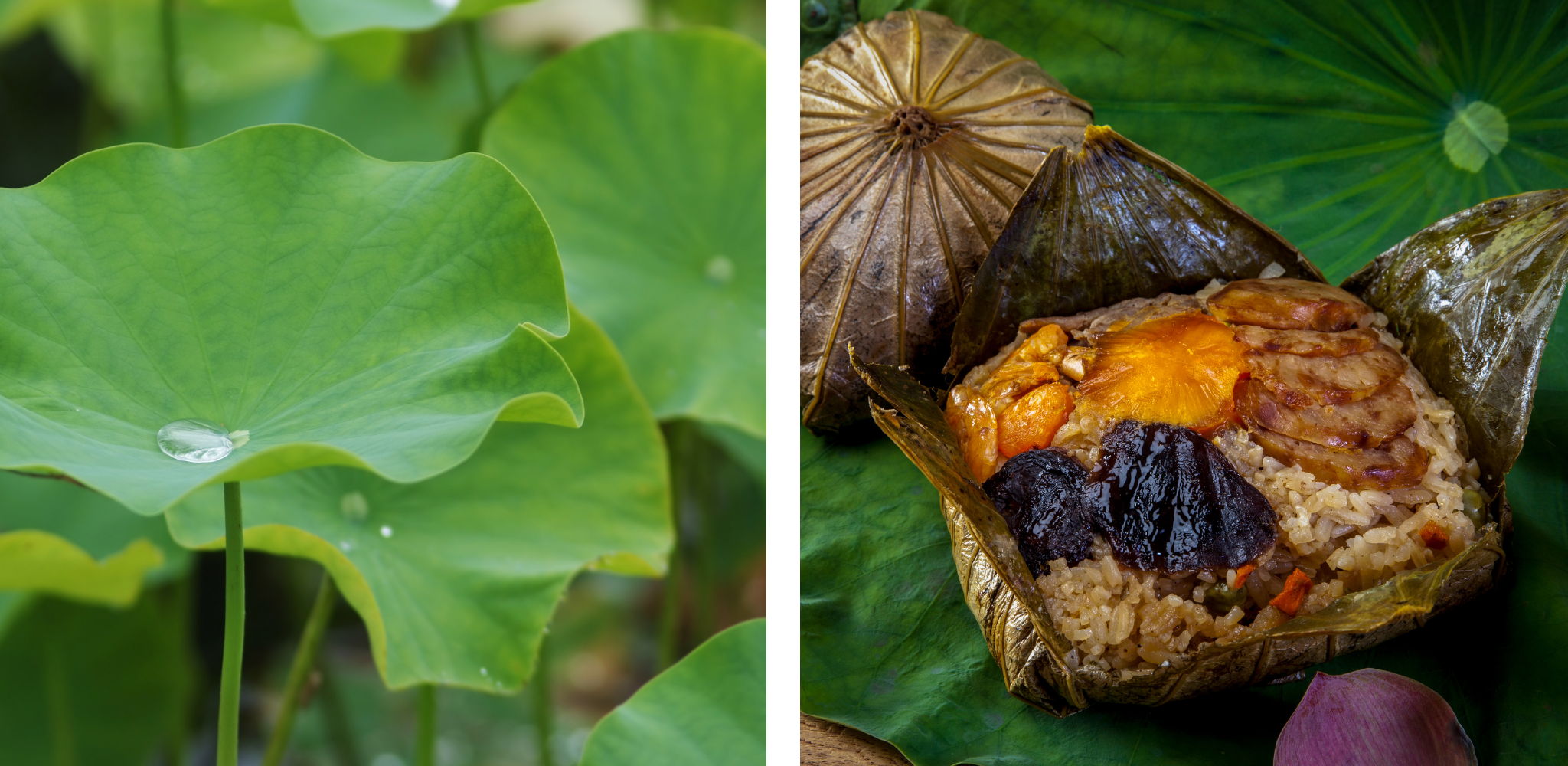
The Leaf: Nature’s Original Food Wrapper
The lotus leaf is almost perfectly designed for the kitchen.
Broad, sturdy, and naturally water-repellent, it can be used to wrap food before steaming, allowing the leaf to act as both vessel and aromatic covering.
In Cantonese cuisine, the lotus leaf is the perfect wrapper for dishes such as lo mai gai (sticky rice chicken) where the ingredients are wrapped in dried lotus leaves and steamed. The leaf gives the food a subtle fragrance while keeping the parcel moist as it cooks.
The practice extends into Southeast Asia. In Thailand and Vietnam, lotus leaves are widely used to wrap rice, steam, and other preparations.
Long before disposable food packaging, the lotus provided its own.
The Root: Japan’s Beautifully Perforated Vegetable
Below the waterline, the lotus offers something entirely different.
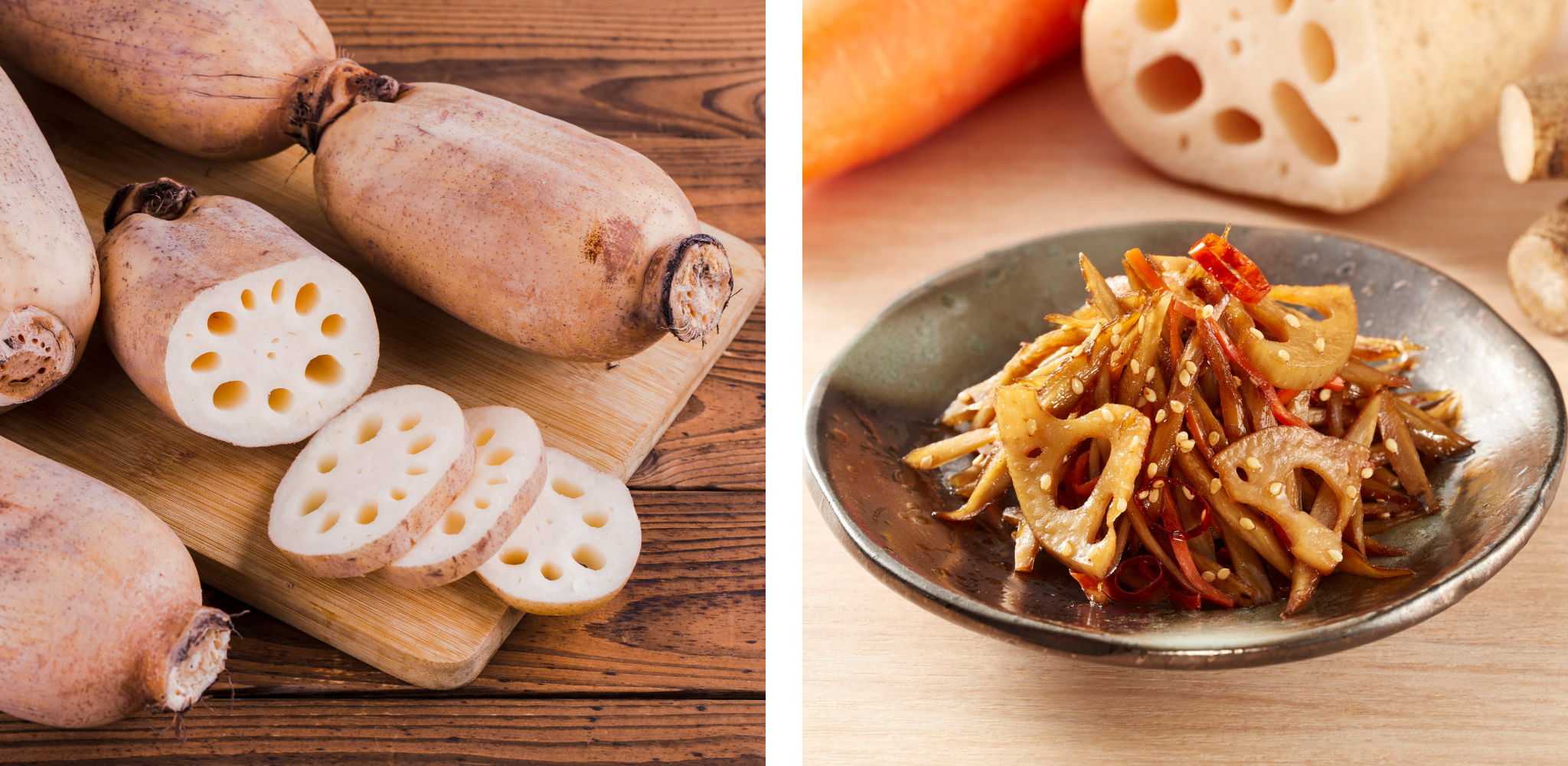
The rhizome, known in Japan as renkon, is one of the country’s most distinctive vegetables. Slice it crosswise and its characteristic pattern of air chambers appears. It is this shape that has also given the vegetable an auspicious symbolism, one associated with the ability to see clearly into the future.
In the kitchen, renkon is remarkably versatile. It can be used in soups and stews, stir-fried, deep-fried or made into tempura. Thinly sliced lotus root becomes wonderfully crisp, while dishes such as kinpira renkon pair its characteristic crunch with the savoury flavours of soy and sesame.
What makes it particularly appealing is that cooking changes its texture without losing its distinctive architecture.
The Stems and Shoots: A Southeast Asian Delicacy
The lotus does not stop at the root.
In Thailand, both lotus stems and young shoots have a place in the kitchen, although they are not the same part of the plant.
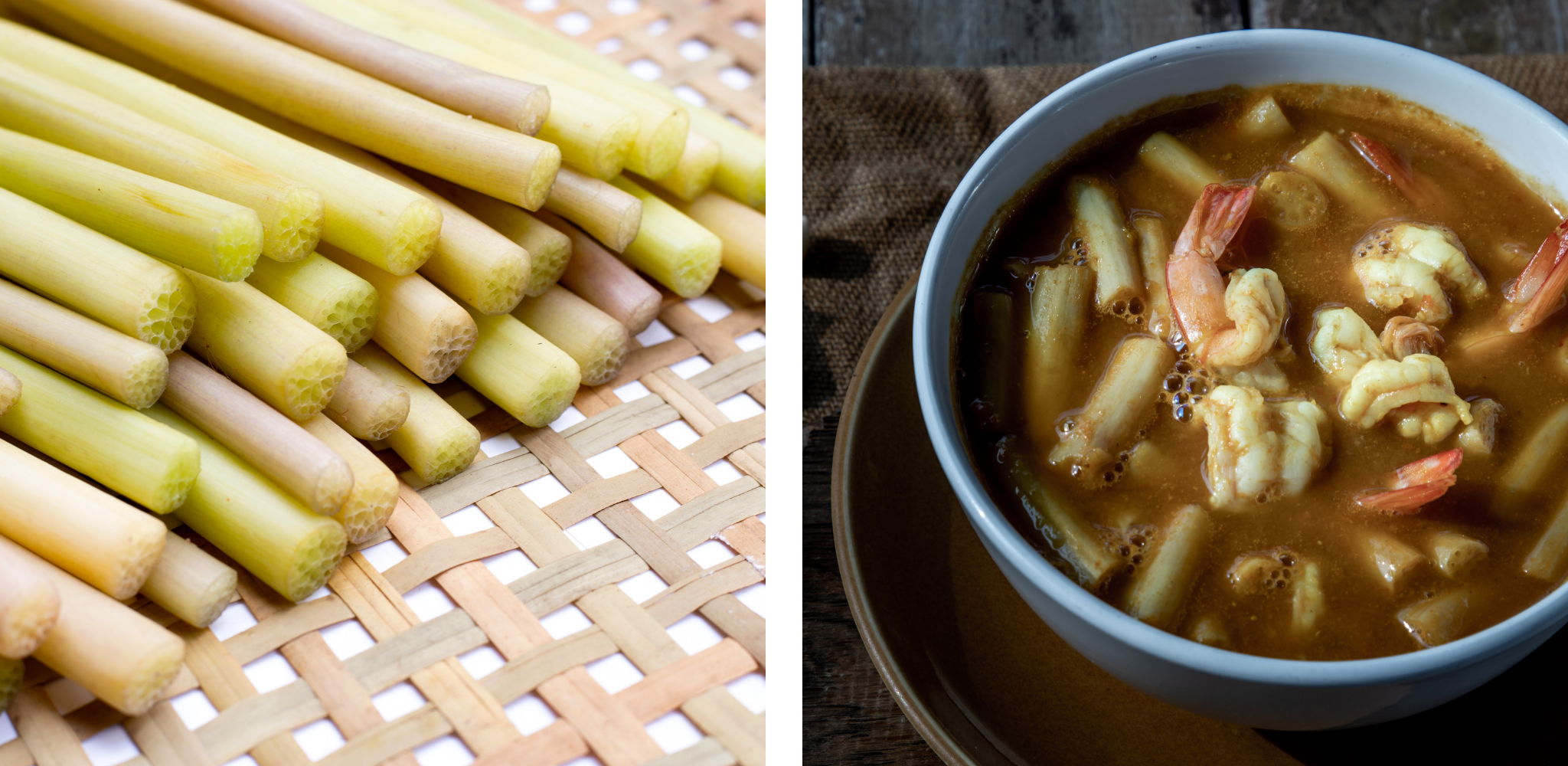
Sai bua refers to the tender stem associated with the flower stalk, while lai bua refers to young underground shoots of the lotus. Both are appreciated for their delicate texture and ability to absorb the flavours around them.
Lotus stems and shoots appear in Thai salads, curries and soups, where their light, crisp texture provides a refreshing contrast to rich coconut milk, sour tamarind, and chilli.
Vietnam has its own tradition. Young lotus stems, known as ngó sen, are commonly used in salads such as gỏi ngó sen, where their clean crunch works beautifully with herbs, prawns and other fresh ingredients.
Again, what might elsewhere be considered a discarded part of the plant becomes an ingredient in its own right.
The Fibre: Lotus Threads of Inle Lake
Perhaps the most extraordinary transformation takes place far from the kitchen, on the waters of Myanmar’s beautiful Inle Lake.
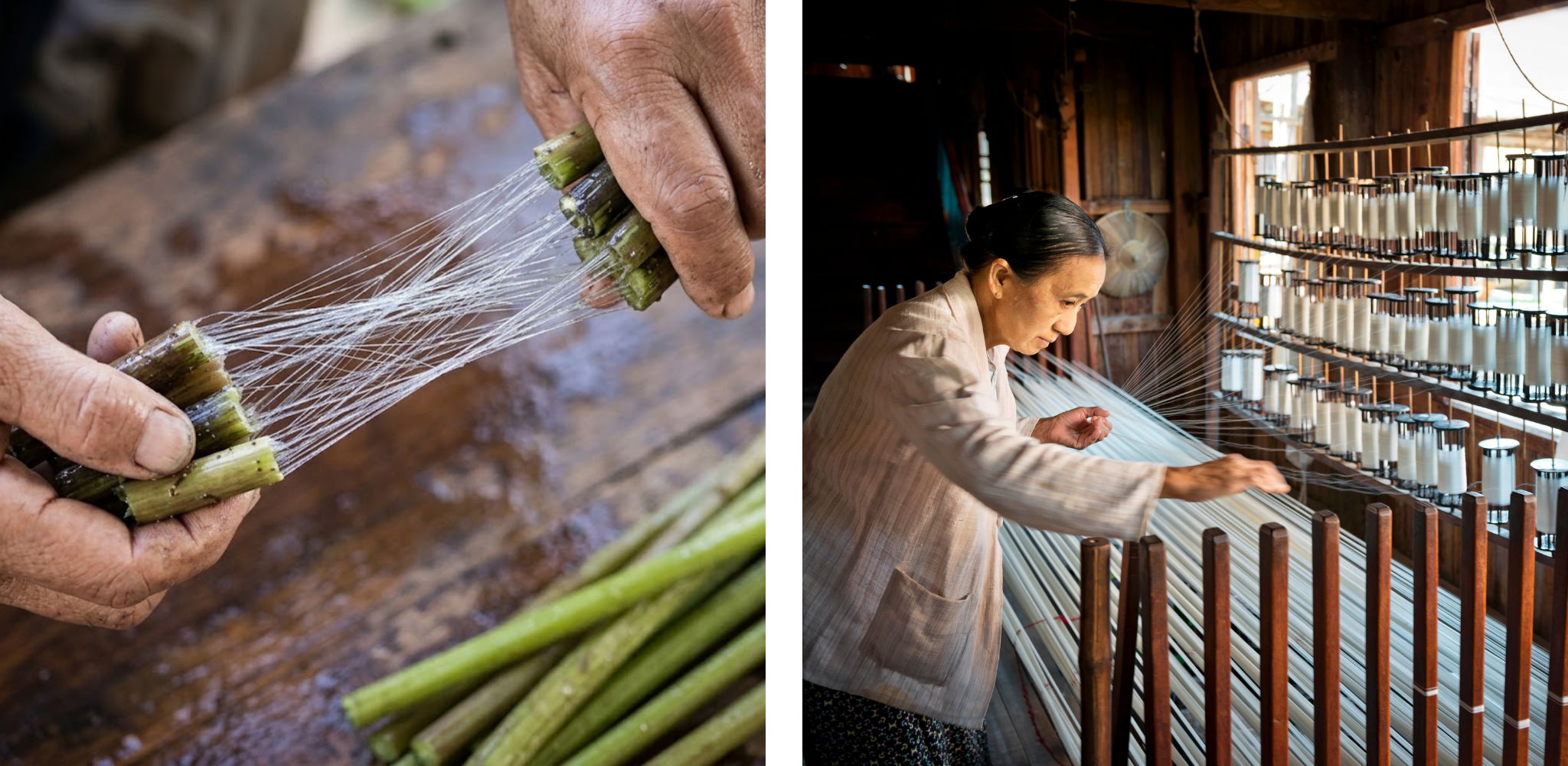
In villages around the lake, particularly Inpawkhon, artisans extract fine fibres from lotus stems and spin them by hand into thread. The practice dates back roughly a century and is traditionally associated with Buddhist devotion.
The process is extraordinarily delicate.
A lotus stem is cut and gently split, revealing almost invisible filaments. These are carefully drawn out, placed together and rolled by hand to form a continuous thread. Thousands of stems may be needed for a single piece of fabric.
The resulting cloth is valued for its softness and rarity, but its deeper significance lies in the craft itself. Today, lotus fibre is woven into robes, scarves and other textiles, while the craft remains closely connected to the Buddhist culture of the Inle Lake region.
A Different Idea of Abundance
Today, we speak frequently about zero waste, circular economies and responsible consumption as though they are entirely new ideas.
Across Asia, however, this principle is much older and much simpler: use what nature gives you, and learn not to waste it.
The lotus makes this philosophy particularly easy to see.
Its flower becomes an offering and, in some places, an ingredient. Its seeds become nourishment and sweets. Its leaves become cooking vessels and food wrappers. Its rhizome becomes a vegetable. Its young stems and shoots become part of regional cuisines. And the delicate fibres hidden inside those stems can be transformed into cloth through extraordinary human patience and skill.
Perhaps this is what makes the lotus such a compelling symbol for a more thoughtful way of travelling, too.
To look beyond the obvious. To understand where things come from. To value the knowledge held within a place. And to recognize that what may appear as insignificant – a stem, a leaf, a seed – may carry an entire tradition within it.
The next time you encounter a lotus pond in Asia, look beyond the flower.
There is far more beneath the surface.